Use this pool salt calculator to estimate how much salt your swimming pool needs. Enter the pool volume, your current salt reading, and the target level recommended for your salt chlorine generator. The result can be shown in pounds, kilograms, or bags, so you can buy and add a practical amount without guessing.
A good calculation starts with a current water test. Even a newly filled pool may already contain some salt, and older pool water can retain a substantial amount from previous treatments. Measuring first helps prevent an overdose, which is much harder to correct than a low reading.
Quick answer: Salt required is based on the pool's water volume multiplied by the difference between the current and target salt levels. If the current reading is already at or above the target, do not add more salt.
How to use the pool salt calculator
Test the water. Measure the current salt level in parts per million, or ppm. Use a reliable salt test or a pool-store test if the chlorinator display seems questionable.
Enter the pool volume. Choose gallons or litres. If you do not know the volume, calculate it from the pool dimensions before estimating the salt dose.
Enter the current salt level. Do not enter zero unless a test confirms that the fill water contains virtually no salt.
Set the target salt level. Use the value in the chlorine generator manual, not a universal target copied from another pool.
Choose a bag size. Common sizes include 40 lb, 20 kg, and 25 kg, but the calculator should accept any package size.
Calculate and add gradually. Treat the result as a measured dose, not a reason to empty every bag at once. Add most of the calculated amount, circulate, retest, and make a smaller final adjustment if needed.
What the calculator measures
A pool salt calculator measures the increase needed from the current salinity to the target salinity. It does not calculate the total salt present in the pool from scratch unless the current reading is genuinely zero.
For example, a target of 3,200 ppm does not mean every pool needs a full 3,200 ppm dose. If the water already tests at 1,200 ppm, the required increase is 2,000 ppm. That difference is the number used in the formula.
Pool salt calculator formula
First calculate the required rise in salt concentration:
PPM increase: Target salt level minus current salt level
Formula for gallons and pounds
Salt to add in pounds: Pool volume in gallons x ppm increase x 8.345 / 1,000,000
Formula for litres and kilograms
Salt to add in kilograms: Pool volume in litres x ppm increase / 1,000,000
Formula for bags of pool salt
Bags required: Salt required divided by the weight of one bag
The bag result may be a decimal. A result of 4.2 bags means the calculated dose is a little more than four bags. You may need to purchase five whole bags, but you should add only the calculated weight and keep the unused salt dry for a later adjustment.
Worked pool salt calculation examples
| Example | Volume | Current | Target | Salt to add | Bag equivalent |
|---|---|---|---|---|---|
| US example | 10,000 gal | 1,200 ppm | 3,200 ppm | 167 lb | 4.2 x 40 lb |
| Metric example | 40,000 L | 1,200 ppm | 3,200 ppm | 80 kg | 4 x 20 kg |
| Small adjustment | 15,000 gal | 2,500 ppm | 3,200 ppm | 87.6 lb | 2.2 x 40 lb |
These examples are mathematical estimates. Test accuracy, actual water volume, salt purity, and water lost during addition can affect the final reading. Retesting remains part of the job.
What salt level should a saltwater pool have?
The correct target comes from the salt chlorine generator, sometimes called the salt cell or chlorinator. Many residential systems work somewhere around 2,700 to 3,600 ppm, but the recommended range and ideal set point vary by model. Some equipment will reduce chlorine production or display a warning outside its operating range.
Use the middle of the manufacturer-recommended range as a cautious target unless the manual specifies a different set point. Avoid choosing the top of the range simply to create a buffer. More salt does not automatically produce safer water, and an excessive level can be difficult to lower.
Below the operating range: The generator may produce less chlorine or stop generating.
Within the recommended range: The cell can operate as designed, provided the rest of the water chemistry and circulation are suitable.
Above the operating range: Some systems report a high-salt warning or shut down. Persistently high salinity can also increase corrosion concerns around susceptible metals and electrical bonding faults.
How much salt does a new pool need?
A pool salt startup calculator uses the same formula, but startup deserves extra care. Test the source water before treating its salt level as zero. If the pool has a new plaster or other cementitious finish, confirm with the builder and finish manufacturer when salt may be added. Startup instructions and warranty conditions can differ.
| Pool volume | Example increase | Estimated salt | 40 lb or 20 kg bags |
|---|---|---|---|
| 10,000 gallons | 0 to 3,000 ppm | 250 lb | 6.3 bags |
| 15,000 gallons | 0 to 3,000 ppm | 376 lb | 9.4 bags |
| 20,000 gallons | 0 to 3,000 ppm | 501 lb | 12.5 bags |
| 50,000 litres | 0 to 3,000 ppm | 150 kg | 7.5 x 20 kg |
The table assumes a true starting level of 0 ppm and a target of 3,000 ppm. Replace those values with your tested current level and the target specified for your equipment.
Pool volume formulas for accurate salt dosing
Salt calculations are only as accurate as the pool volume. Use the average water depth, not the wall height, and measure irregular pools in sections when possible.
Rectangular pool in gallons: length in feet x width in feet x average depth in feet x 7.48
Round pool in gallons: diameter in feet x diameter in feet x average depth in feet x 5.87
Oval pool in gallons: length in feet x width in feet x average depth in feet x 5.87
Rectangular pool in litres: length in metres x width in metres x average depth in metres x 1,000
Round pool in litres: diameter in metres x diameter in metres x average depth in metres x 785.4
Free-form pools are usually best divided into simple shapes and added together. If the builder supplied a documented volume, that figure is generally more useful than a rough estimate from maximum dimensions.
Using the calculator for above-ground and Intex-style pools
The same salt formula works for an above-ground pool, including many framed and soft-sided models. The important inputs are actual water volume, current ppm, and the target for the installed salt system. Do not assume that a pool described as 12 feet by 30 inches is filled to the full 30-inch wall height. The operating water depth is lower, so a manufacturer-listed capacity is usually the better input.
Also confirm that the liner, fittings, ladder, heater, and other connected equipment are approved for use with a salt system. The calculator can estimate a dose, but it cannot determine whether the pool hardware is suitable for saltwater operation.
How to add salt to a pool safely
Confirm the dose and product. Use pool-grade sodium chloride of high purity and check the label for unwanted additives. Avoid iodized table salt, rock salt, and products containing stain-prone or unnecessary ingredients.
Follow the equipment instructions. Many manufacturers advise switching the salt generator off while salt is being added, while leaving the circulation pump running. Use the procedure stated in your manual.
Distribute the salt across the pool. Spread it over the surface rather than pouring it into the skimmer or leaving a concentrated pile on the floor.
Brush until dissolved. Move settled crystals so they do not sit against a liner or finish.
Allow thorough circulation. Wait until the salt has dissolved and mixed through the water. Retest after the circulation period recommended by the salt and equipment manufacturers.
Make the final adjustment. If the new reading is still low, add a smaller measured amount. This is safer than correcting an overshoot.
What kind of salt should you use?
Choose salt sold for swimming pools or another product explicitly approved by the chlorinator manufacturer. Look for high-purity sodium chloride that dissolves cleanly and does not contain iodine, fragrances, colorants, or other treatment additives. A fine crystal usually dissolves faster than a large pellet, although product suitability matters more than crystal shape.
The calculator works by weight, so a 40 lb bag and a 20 kg bag can both be used when the correct unit is selected. Salt purity can cause a small difference between the theoretical dose and the final water reading, which is another reason to add gradually and retest.
How to lower a high pool salt level
There is no normal pool chemical that selectively removes excess salt. The practical correction is usually to remove some pool water and replace it with lower-salt water. Before draining, confirm the reading with a second test and check local discharge rules, groundwater conditions, and any limits that apply to the pool structure.
Replacement fraction: (Current ppm minus target ppm) divided by (current ppm minus replacement-water ppm)
If the pool tests at 4,000 ppm, the target is 3,200 ppm, and the replacement water is effectively 0 ppm, the estimated replacement is 20% of the pool volume. If the fill water already contains salt, a larger water exchange is needed. Partial drain-and-refill cycles may be safer for some pools than one large drain.
Why the salt reading may not match the calculator
A calculator produces a mass balance based on the numbers entered. A different result in the pool usually points to an input or measurement issue rather than a different formula.
The pool volume is overestimated or underestimated.
The original salt test was inaccurate or taken before the water was fully mixed.
The salt cell's displayed value is affected by temperature, scaling, age, or calibration.
Salt remained undissolved when the follow-up test was taken.
Water was lost through backwashing, splash-out, overflow, a leak, or partial draining.
The test method is responding differently to dissolved minerals and other dissolved solids.
When the chlorinator display and an independent salt test differ substantially, do not keep adding salt to make the display change. Confirm the water with a reliable test and inspect or service the sensor or cell if needed.
Salt level is only one part of pool chemistry
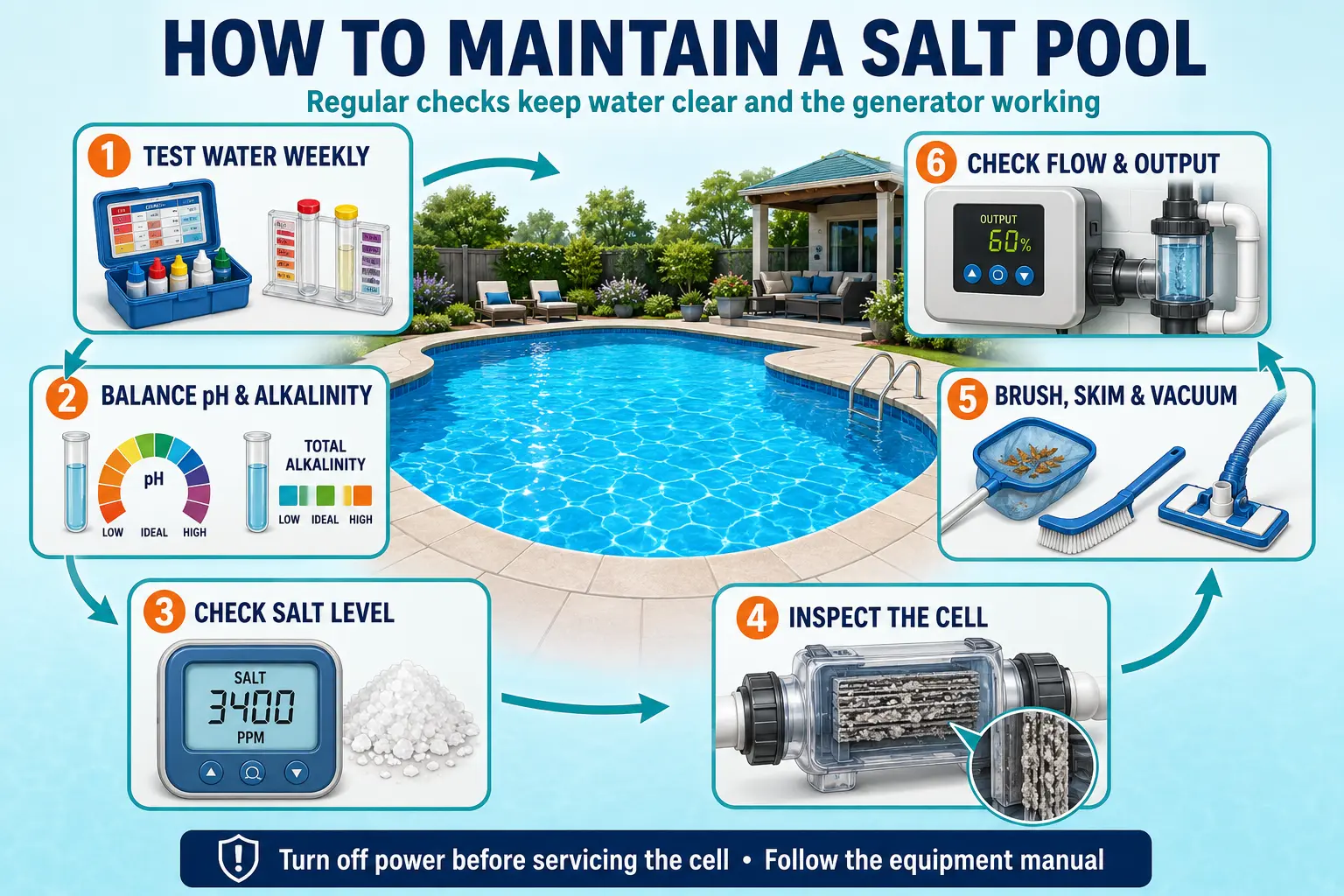
A salt water pool calculator does not replace a complete water test. The chlorine generator still depends on suitable free chlorine, pH, total alkalinity, cyanuric acid, calcium hardness, circulation, and cell condition. Adjustments for stabilizer, muriatic acid, calcium chloride, or other pool chemicals require separate calculations based on their own test results.
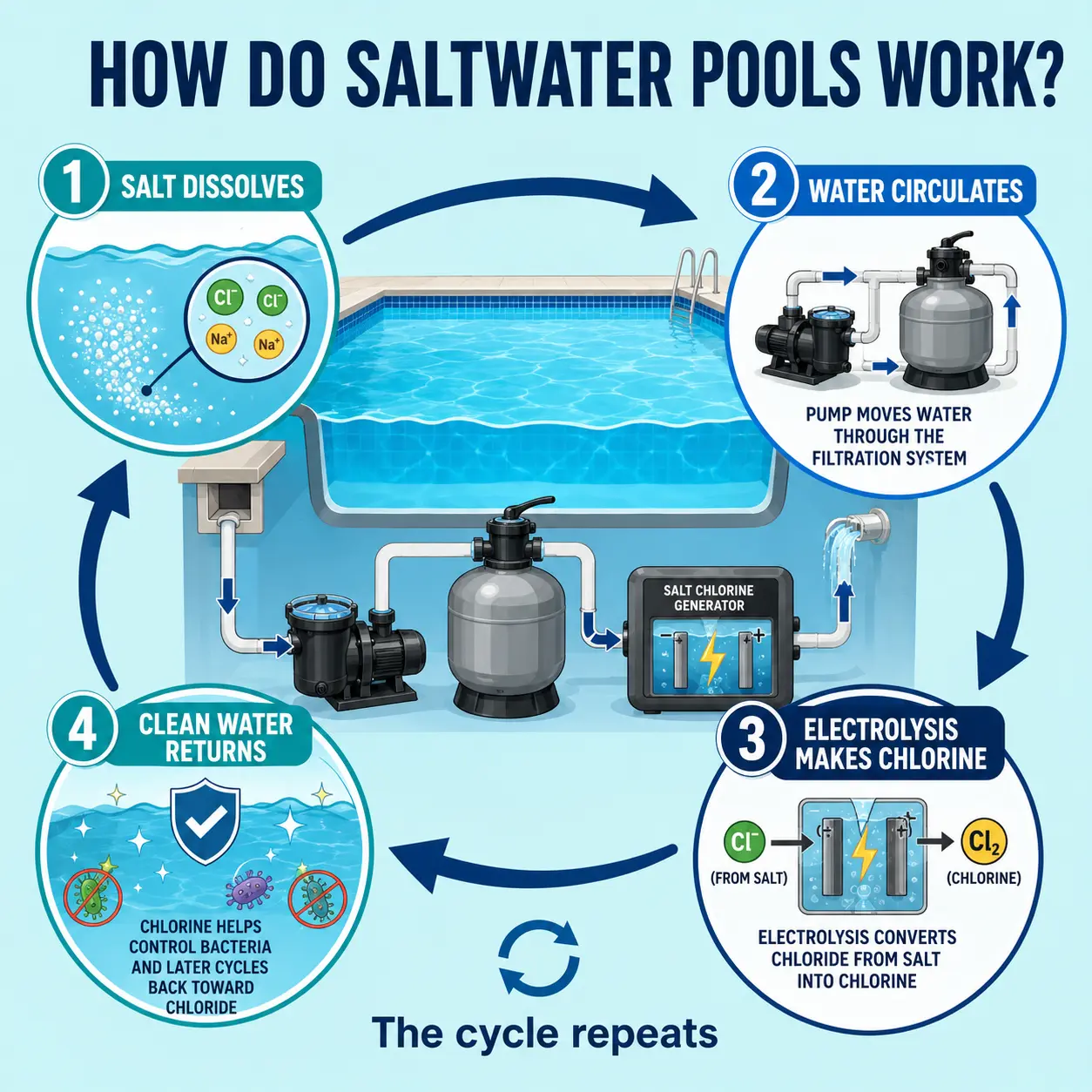
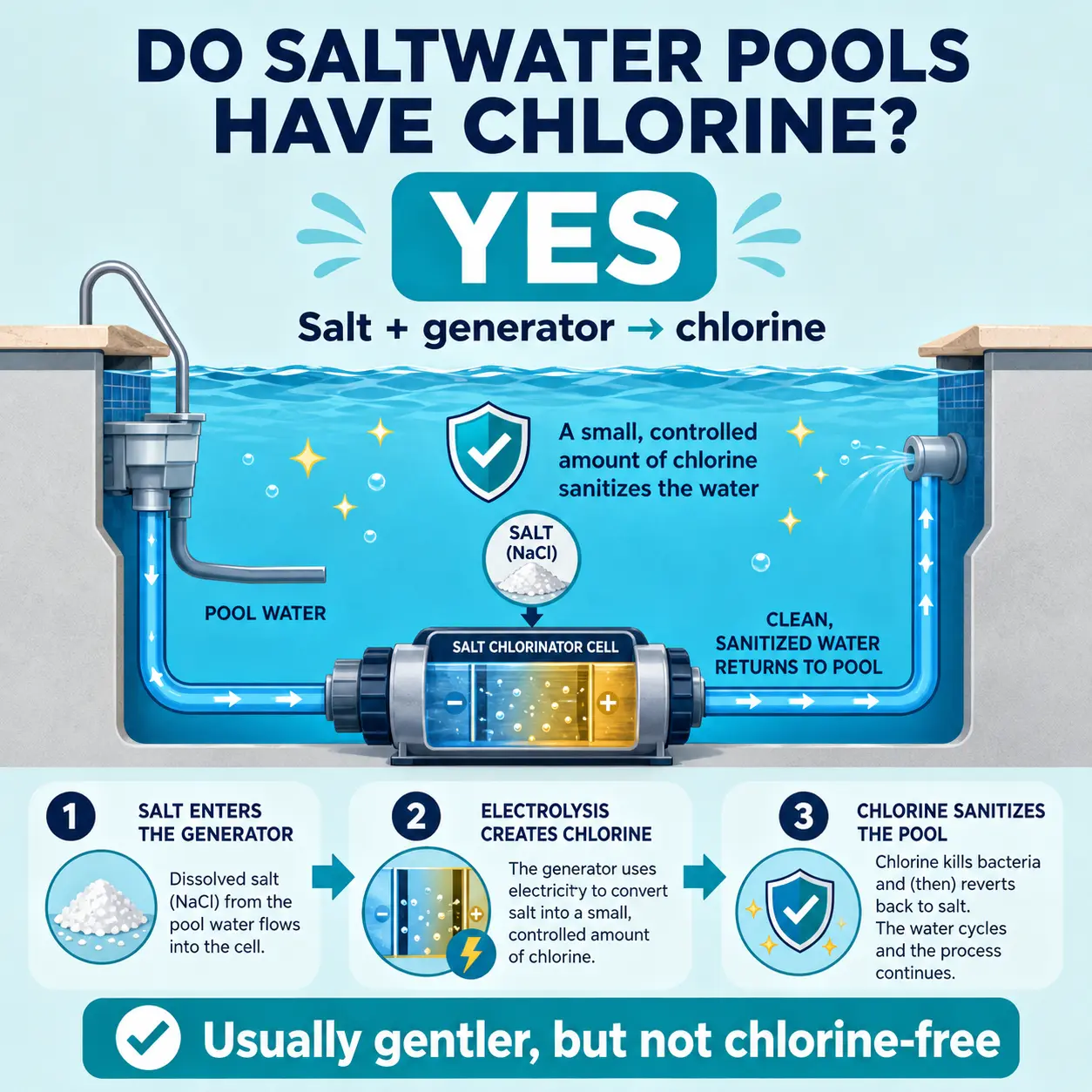
Salt itself is not consumed each month in the way chlorine is. It remains in the water as the generator cycles chloride through its process. Routine salt loss mainly occurs when water leaves the pool through splash-out, overflow, backwashing, leaks, or draining. Top up only after testing, not on a fixed monthly schedule.
Common pool salt calculation mistakes
Guessing the pool volume. A 10% volume error creates roughly a 10% dosing error.
Assuming the current level is zero. Source water and previous chemicals may already contribute salt.
Using the wrong target. The correct ppm comes from the installed generator, not a different brand or model.
Mixing units. Do not enter litres as gallons or kilograms as pounds.
Adding the purchase quantity. Buying five bags because the result is 4.2 bags does not mean all five bags belong in the water.
Dosing all at once. A staged addition gives you room to correct for test and volume uncertainty.
A more reliable way to manage pool salt
The best pool salt calculation is a short cycle: measure, calculate, add gradually, circulate, and retest. That process takes a little longer than guessing by bag count, but it protects the pool from an avoidable high-salt correction and gives the chlorine generator a better chance to operate within its intended range.
Use the pool salt calculator whenever water has been replaced, the system reports a low-salt condition, or a verified test shows the level has moved below the target. Let the test result, pool volume, and equipment manual guide the dose.